Tip: Activate javascript to be able to use all functions of our website
Tip: Activate javascript to be able to use all functions of our website
1 June 2026

German exporters are facing major challenges in a world increasingly characterised by geopolitical tensions. How can companies benefit from the Federal Government’s export funding programmes and use them strategically for fixed-interest financing?
In an interview with Andreas Gehring, Product & Innovation Manager at Euler Hermes AG, Liane Pöhlking, Vice President at KfW IPEX-Bank gives an insight into how the CIRR programmes work and their innovative features.
Pöhlking: The CIRR programmes are funding instruments provided by the Federal Government that support German export companies in their dealings with emerging and developing countries. KfW acts as a mandatary of the Federal Government and commissions KfW IPEX-Bank with the practical implementation of the programmes.
There are two main CIRR programmes: Firstly, there is the ERP export financing programme (ERP CIRR), which specifically supports small and medium-sized enterprises and provides funds from the ERP special fund. Secondly, there is the Africa CIRR programme, which primarily supports large-volume export transactions starting from EUR 85 million via the Federal Government’s budget funds. In addition, the CIRR Ship Refinancing Scheme is an industry-specific programme that promotes exports from German shipyards to destinations all over the world. I will not go into more detail about this special programme here.
Under the two programmes mentioned, foreign buyers or their local banks receive loans at a fixed interest rate. The loans are tied to supplies, in euros or US dollars, and interest rates are based on the CIRR rate. These loans are granted by banks that are entitled to apply for export finance guarantees. KfW acts as a refinancier for these banks.
The CIRR (Commercial Interest Reference Rate) is set monthly by the Organisation for Economic Co-operation and Development and serves as the minimum reference rate for state-subsidised export finance.
The CIRR ensures transparency and competitiveness in interest rates and guarantees fair market conditions.
Pöhlking: The objective is clear: CIRR programmes are intended to enable exports through favourable and stable financing, reduce risks and thus ensure international competitiveness. The regulations set out by the OECD consensus create reliable underlying conditions, a so-called level playing field, for buyers and lenders. This also contributes to the ability of complex and high-risk projects to receive financing.
Pöhlking: The applicant bank issues a supply-linked financial loan on a fixed-interest basis. This can be issued directly to a buyer or a bank and may be denominated in euros or US dollars. An important criterion is the existence of an export finance guarantee covering the commercial loan provided. In addition, the OECD consensus specifies further key requirements for financing, for example with regard to loan duration and repayment terms. There are also special requirements that vary depending on the CIRR programme.
Objective of the programme: Supporting small and medium-sized German companies in financing export transactions by providing funds from the ERP Special Fund
Volume per application: generally < EUR 150 million
Group of countries: Buyers based in countries on the DAC list*
Link to SMEs: SME or indirect link to SMEs (> 20%)
Special features: Standard ceiling may be adjusted if necessary
Objective of the programme: Supporting the financing of large-volume export transactions by providing funds from the German federal budget under the Africa CIRR programme
Volume per application: generally > EUR 85 million
Group of countries: Buyers in Africa and, more recently, in countries on the DAC list*
Link to SMEs: not necessary
Special features: Prior application required
*The DAC list is a directory issued by the OECD that lists all emerging and developing countries
Pöhlking: In order to further expand the use of these fixed-rate export finance schemes, the programmes were reviewed by the responsible units of the German Federal Ministry for Economic Affairs and Energy (BMWE). The findings from a survey of banks and exporters were incorporated into this review. The aim is to make the programmes more effective, more flexible and better adapted to market demand.
The eligibility for the use of ERP CIRR has been widened: Larger companies that do not meet the definition of SME can also use the programme, provided that at least 20% of the supplies come from the SME sector – this quota has been lowered to reach more companies.
The country focus of the Africa CIRR programme has been significantly extended. Rather than focusing on Africa, funding is now available to all countries on the DAC list, which represents a huge expansion with a wide range of new opportunities. The name “Africa CIRR” will therefore also be adjusted soon.
Both programmes can now also be applied for together, as they have the same country focus. For example, it is now possible to apply for refinancing for a major project in India with a volume of 350 million euros. Suppose the exporter is not an SME but supplies from SMEs amount to 30 million euros. In order to meet the required SME supplier share of at least 20%, 150 million euros could, in this case, be provided from ERP funds and the remaining 200 million euros from the Africa CIRR programme, provided all eligibility criteria are met.
All in all, this enables us to support projects of all sizes, from very large to small, as there is no minimum amount for the ERP CIRR.
Pöhlking: The exporter brings up the possibility of financing at a long-term fixed interest rate based on CIRR in discussions with the buyer. They can also offer to establish contact with a financing bank. Sometimes buyers request CIRR-based financing on their own initiative. If the buyer opts for the CIRR fixed rate, the bank will apply to us at KfW IPEX-Bank for inclusion in the programme. We will take care of the next steps and processing of the application. This mainly includes obtaining approval from the Federal Government and concluding a refinancing agreement with the applicant bank.
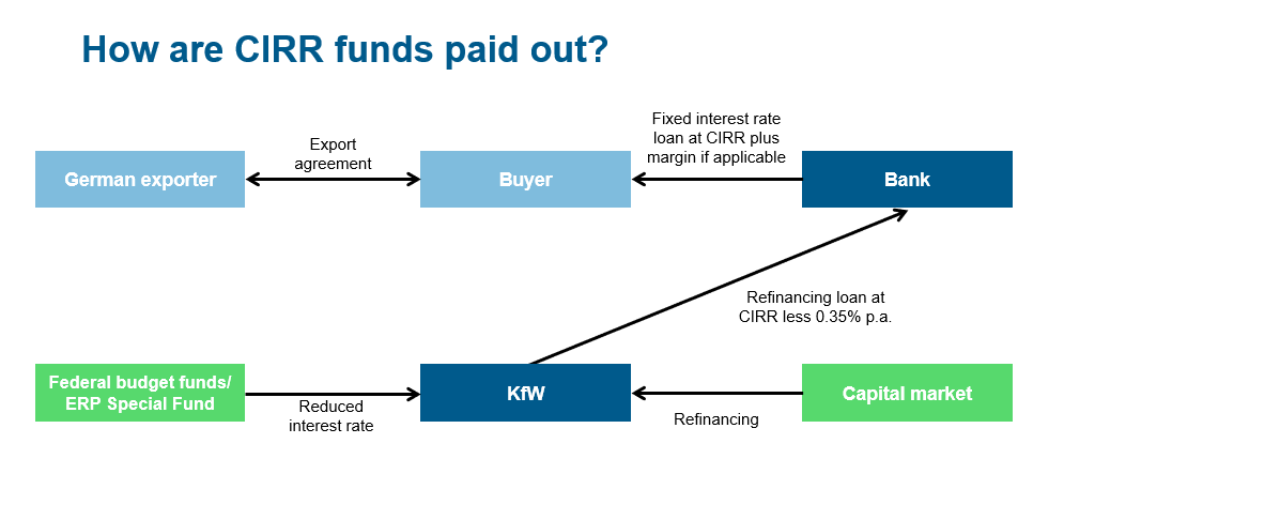
Pöhlking: CIRR-based financing offers buyers reliable and long-term planning security at a fixed interest rate. Support for financing and the mention of these long-term fixed-interest options can be crucial for the exporter when dealing with the buyer. This means the CIRR instrument can certainly be seen as a “business enabler” for the exporter.
With the CIRR programmes German exporters therefore have access to an important instrument for gaining a foothold and winning contracts in complex global markets. Banks also benefit from long-term refinancing via KfW.
Share page
To share the current page content with your network, click the button below and then select the desired option in the dialog box.
Note on data protection: By clicking the button, your browser's sharing function is used. If you select an external provider when sharing, personal data may be processed by the provider. Please read our data protection principles for more information.
Your browser does not support sharing with external services.
Alternatively, you can also copy the short link: https://www.kfw-ipex-bank.de/s/enxCAJnt
Copy link Link copied